 DevPOS
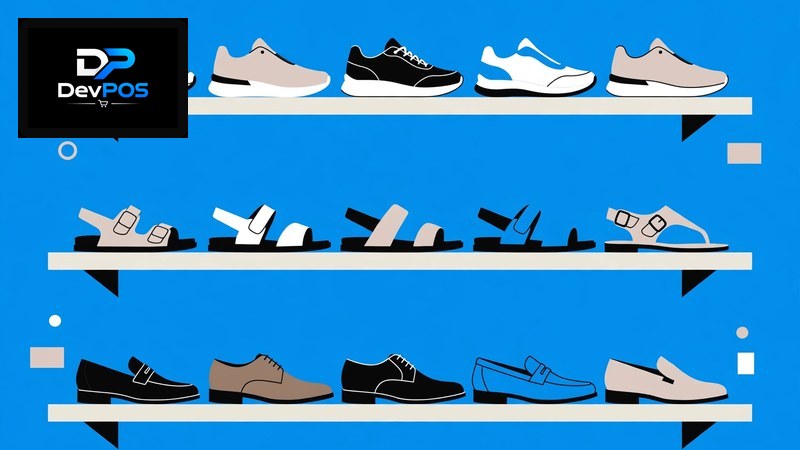
> Short answer: A shoe shop's real problem is the size matrix: one design in 8 sizes and 3 colours is 24 separate stock items. Shoe store software in Pakistan tracks every size individually, warns you before a size runs out, and bills in under a minute. It costs Rs 1,499 a month — less than the margin on 3 pairs of school shoes — with a 15-day free trial and no card.
Shoe Store Software in Pakistan: Sizes & Stock
A shoe shop looks simple from the outside: boxes on shelves, customers trying pairs. Inside, it is one of the hardest shops to manage. One design comes in sizes 6 to 11, in black, brown and tan. That is 18 stock lines for a single design, and you probably carry 60 designs. Nobody's memory — and no paper register — can track 1,000+ size-level stock lines accurately.
Why shoe shops are harder than they look
The customer asks: "Is mein 9 number black mein hai?" Your salesman disappears into the godown for five minutes, comes back empty-handed, and the customer leaves. Meanwhile there were three pairs of size 9 black sitting in a box nobody checked.
Paper registers record "Shoe X sold — 1 pair." They never record the size. So at month end you know you sold 400 pairs but you cannot answer the only question that matters: which sizes of which designs need reordering? You reorder by guess, overstock the slow sizes, and run out of the fast ones right in the middle of Eid season.
What the software tracks for you
- Size-wise stock for every design — each size of each colour is its own line. Sell a size 8 black, and only that line drops. You always know exactly what is on the shelf and in the godown.
- Low-stock alerts per size — set a minimum, say 4 pairs. The moment size 9 of your best-selling school shoe hits 3, you get flagged. You reorder before the shelf goes empty, not after customers start complaining.
- Fast billing at the counter — scan or select the design, pick the size, print the receipt. A sale that took 3 minutes of writing now takes 30 seconds, which matters when 10 customers are in the shop on a Sunday.
- Season and sale reports — see which designs moved during Eid, which school shoes peak in March-April, and which fancy designs only sold during wedding season. Next year's buying becomes a decision, not a gamble.
- Exchange and return handling — customer brings back size 8 for size 9. The exchange is recorded properly: stock goes back up for one size, down for the other, and the hisab stays clean.
Eid, school season, and sale time
Shoe sales in Pakistan run on seasons: Eid-ul-Fitr, Eid-ul-Adha, back-to-school in March, and winter for boots and joggers in cities like Rawalpindi and Peshawar. The shops that make money are the ones that stocked the right sizes before the rush. With last year's size-wise sales in front of you, you order 40% more of size 9 in school shoes instead of ordering everything equally and hoping. That single decision can be worth Rs 200,000 in a season.
How the options compare
| What you need | DevPOS shoe module | Generic POS | Paper register |
|---|---|---|---|
| Stock tracked per size & colour | Yes | Rarely | No |
| Low-stock alert per size | Yes, automatic | Manual checks | Memory |
| Billing speed at rush hour | Under a minute | 1–2 minutes | 3+ minutes |
| Season-wise sales report | Yes | Basic | No |
| Exchange/return recording | Yes, stock auto-adjusts | Partial | Messy overwriting |
| Monthly cost | Rs 1,499 | Rs 2,000–4,000 | Rs 0 + wrong orders |
How much will it cost?
The shoe store module runs on the Essential plan at Rs 1,499 per month. Billing, size-wise stock, alerts, exchanges and all reports are included — nothing is charged per feature. You get a 15-day free trial with no card. Payment is manual and simple: JazzCash, Easypaisa or bank transfer, send the receipt, and your account is approved. Check pricing for the full comparison, or start your free trial and enter your current stock this week.
Frequently asked questions
I have 1,000+ pairs in stock. How long does data entry take?
Most shops finish in 2–4 days, entering design by design during quiet hours. You only do it once — after that, every sale and purchase updates stock automatically. Start with your 20 fastest-moving designs and add the rest gradually.
Can it handle different size systems (UK, EU, kids' sizes)?
Yes. You define the size range per design — UK 6–11 for men's, EU sizes for imported lots, or 11–2 for kids' school shoes. Each design keeps its own size set, so mixed stock is not a problem.
What if a customer exchanges a pair after 3 days?
Record it as an exchange: the returned size goes back into stock, the new size comes out, and any price difference is settled on the bill. The daily cash report stays accurate and you can see your exchange rate per month.
Does it work for wholesale shoe dealers too?
The size-wise stock and billing work the same. If you also supply retailers on credit, the wholesale module — on the Professional plan at Rs 1,999/month — adds bulk pricing tiers and udhaar recovery tracking. See wholesale software in Pakistan for details.
My shop is small — just me and one helper. Is software overkill?
A small shop feels stock mistakes the hardest, because every dead pair on your shelf is cash you cannot use. Rs 1,499 a month is less than the margin on 3 pairs of school shoes. If it saves you one wrong bulk order a year, it has paid for itself many times over.